How SSDs Fail: Wear, Data Retention and Power Loss
Solid state drives fail through finite write endurance, data retention limits, and vulnerability to power faults. Field studies show raw bit error rates grow slowly with wear and are not predictive of uncorrectable errors. Power fault testing found most tested SSDs exhibited failures like bit corruption and metadata corruption.
Wear and Endurance
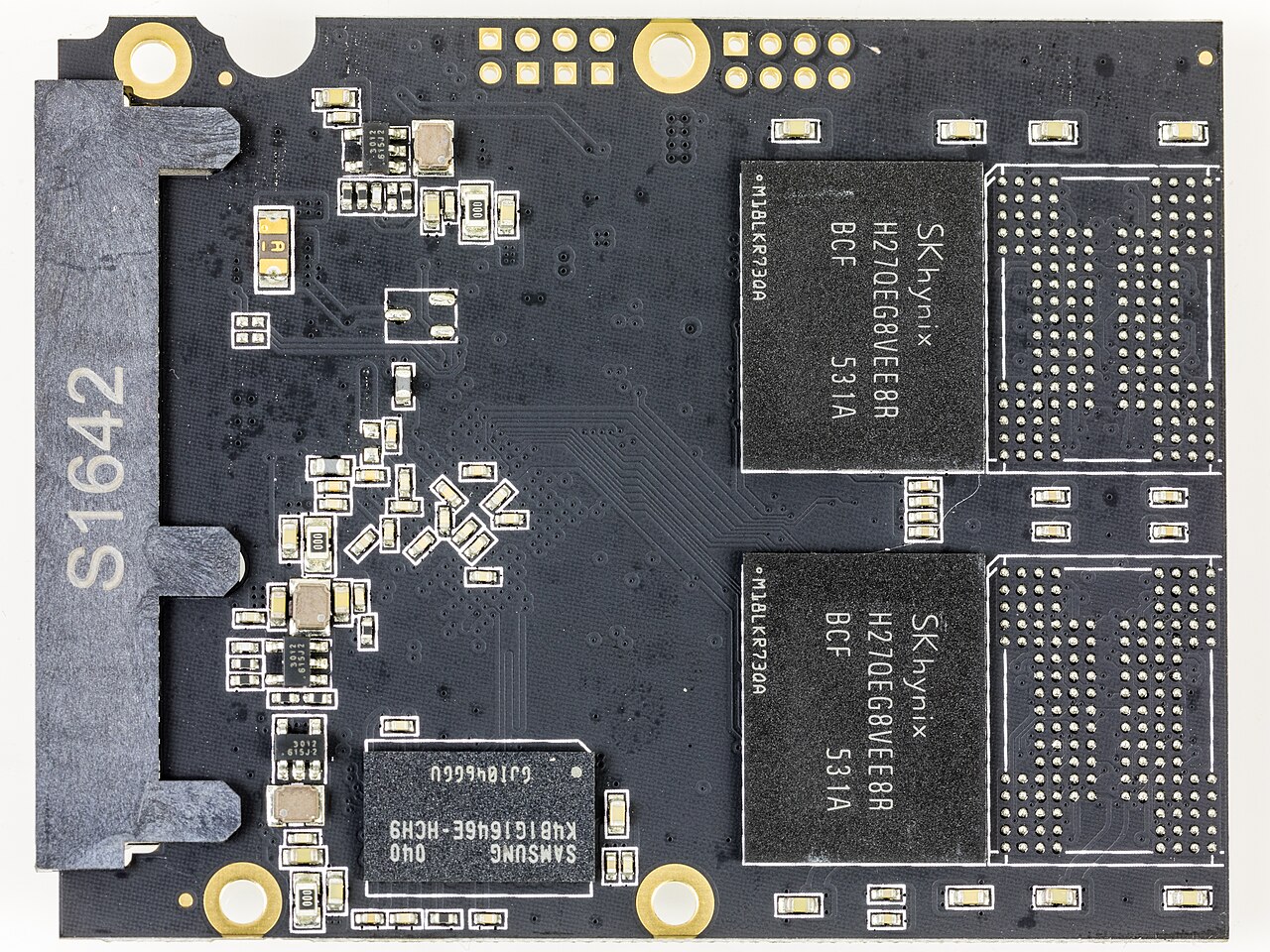
SSDs store data in NAND flash cells that can be programmed in pages and erased in blocks. Each cell can hold one to five bits, and storing more bits per cell typically reduces endurance and performance, as explained by SNIA's SSD overview.
Endurance is finite and is specified by vendors as terabytes written (TBW) or drive writes per day (DWPD). Actual endurance varies with workload and free space, because firmware uses free space for garbage collection. Datacenter drives may handle petabytes written, while consumer drives often have only a few hundred TBW.
A large-scale field study by USENIX FAST researchers found that raw bit error rates grow much slower with wear than the commonly assumed exponential rate. More importantly, raw bit error rates are not predictive of uncorrectable errors or other error modes.
The same study found no correlation between the number of reads and the number of uncorrectable errors, making the uncorrectable bit error rate (UBER) not a meaningful metric. It also saw no indication that premium SLC drives outperform MLC drives in reliability during normal service life.
Data Retention and Power Loss
Data retention refers to how long stored data remains readable without power. NAND flash cells lose charge over time, and the retention period depends on the number of program/erase cycles and temperature. The Samsung internal SSD troubleshooting FAQ advises using TRIM and garbage collection to maintain performance, but does not specify retention figures.
Power faults are a separate failure mode. A study presented at USENIX FAST injected power faults into fifteen commodity SSDs from five vendors over more than three thousand fault injection cycles. Thirteen of the fifteen devices exhibited surprising failure behaviors, including bit corruption, shorn writes, unserializable writes, metadata corruption, and total device failure.
These findings highlight that SSDs are not immune to sudden power loss, even though they have no moving parts. The Solidigm SSD vs HDD guide notes that SSDs are faster and more power efficient than HDDs, but endurance depends on the existing data layout because writes occur in pages while erases happen in blocks.
Comparing Failure Rates with HDDs
The USENIX FAST field study compared flash drives with hard disk drives in production data centers. It found that flash drives have a significantly lower replacement rate in the field, but they have a higher rate of uncorrectable errors.
Backblaze publishes open-source drive reliability data, including annualized failure rates (AFR) for HDDs and SSDs in their data centers. The Backblaze Drive Stats page shows lifetime AFR for all drives at 1.41%, but it does not break down SSD-specific rates in the provided text.
When comparing SSDs and HDDs, the Solidigm guide explains that HDDs use spinning disks and are lower in cost, making them practical for cold data that is not accessed frequently. SSDs are faster and more power efficient, but their endurance is finite.
| Failure mode | Description | Observed in study |
|---|---|---|
| Bit corruption | Individual bits in stored data change value | Yes |
| Shorn writes | Partial write of a block or page | Yes |
| Unserializable writes | Writes appear out of order | Yes |
| Metadata corruption | File system or drive metadata damaged | Yes |
| Total device failure | Drive becomes unresponsive or unusable | Yes |
Frequently asked questions
What is SSD endurance?
SSD endurance is the amount of data that can be written to the drive before it wears out. It is specified as terabytes written (TBW) or drive writes per day (DWPD), and varies with workload and free space.
How does power loss affect an SSD?
Power loss can cause bit corruption, shorn writes, unserializable writes, metadata corruption, or total device failure, as shown in a study that tested fifteen SSDs under power faults.
Are raw bit error rates predictive of SSD failure?
No. A field study found that raw bit error rates grow slowly with wear and are not predictive of uncorrectable errors or other error modes.
Do SSDs fail more often than HDDs?
In a large field study, flash drives had a significantly lower replacement rate than HDDs, but they had a higher rate of uncorrectable errors.
What can be done to maintain SSD performance?
Using TRIM and garbage collection helps maintain performance. On some operating systems, TRIM runs automatically. Secure Erase can also be used, as described in Samsung's troubleshooting FAQ.